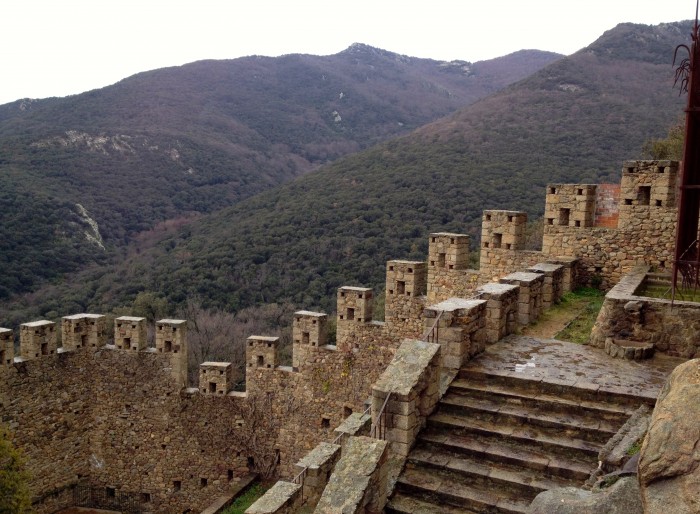
REQUESENS
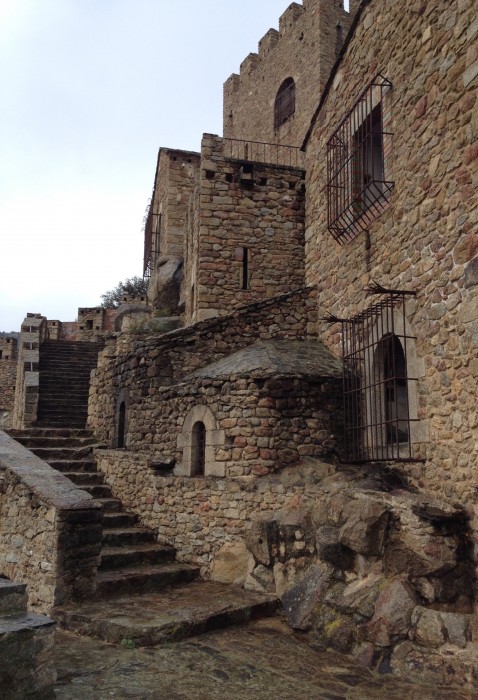
The old village of Requesens is located on the south side of Puigneulos at 1,255m, which is also the source of Anyet (or the stream of Requesens, as it is called locally).
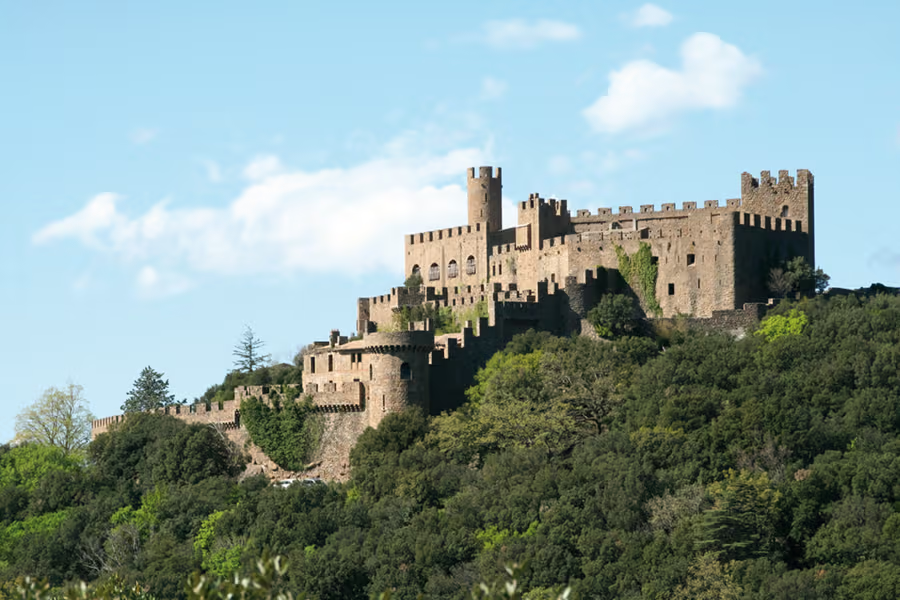
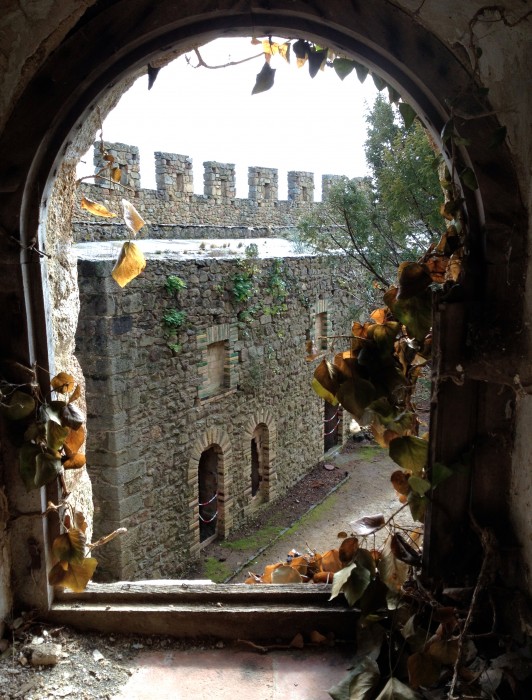
Situated amidst cork oak forests and abandoned farms, in the clearing to the left of the stream, you can see the castle atop the 511m high hill, overlooking the church building, which was the original parish sanctuary dedicated to Our Lady.
The first existing documents of the place were in a ‘Carles de Calb’ rule of life in 859, the Peralada Pagus (villare quod vocant Richusins). The castle appears documented from the mid-11th century, and its history has been studied by P. Negre from the archives of the Dukes of Medinacelli.
The castle was built by Gausfred II after the division of the provinces of Rosello and Empuries. It was built on the plot of land that his uncle, Count Huges I of Empuries, had entrusted to him, and this later became a source of disagreement between the two provinces.
The castle remained dependent on the support of the Counts of Rosello until the 12th century, but by that time connections had already been established with the Rocaberti line, who had purchased the property and continued to hold jurisdiction over the area until the modern era.
REQUESEN AND THE CASTLE
ALMOST A STORY WITHOUT HISTORY
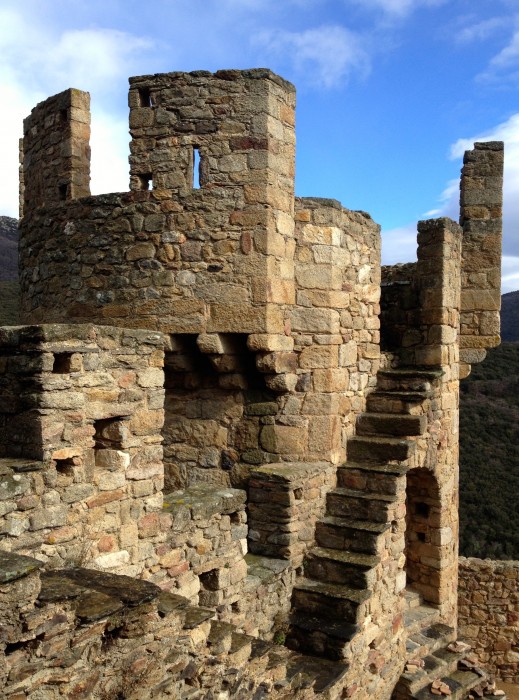
In general, when we speak of a castle, we imagine warring armies coming to the ground with clashing swords.
On the other hand, we do have written accounts of the bloody event that actually took place on site to provide evidence of war. This could easily give us a false impression that a war never actually took place.
Not only do we have no records of a battle near the castle, but we are also not certain of the origins of the Castle – who built it, and why.
We do know that in 859 Humfrido (probably of divine descent) gifted the castle to Oriol, which suggests that they may have been the founders of the castle.
Other stories, however, lead us to believe that the original castle was built by the Counts of Rousillon.
By the end of the 9th century, the history of Humfrido and Oriol was lost in the sands of time. The Counts of Roussillon remain among the more colorful figures in the history of the region, even though the precise role they played in the construction of the castle remains unclear to this day.
All this took place around the 12th century, at the time of the Crusades to the Holy Land, during which the Cathars continued to hold power in Occitanie, Roussillon, and the Pyrenees.
At this time, the Alberes Mountains, along with a large part of the Pyrenees, lay within a Catalan kingdom that extended far into France, unlike today, when the mountains delineate the border between the two countries.
In those days, the reach of the Catalan kings extended across the mountains to the whole of Occitania.
But this Catalan personality was dramatically extinguished on September 9, 1213. While fighting against the mercenaries of Simon de Montfort in support of the Counts of Toulouse, the Catalan king Peré the Catholic (father of James I) was tragically killed in battle. Shifting from matters of politics and war to matters of commerce, Requesens Castle had stood for centuries alongside a popular trade route, with many merchants traveling from the plains of Roussillon in the north to the plains of Emporda in the south, via the Albera mountains and the Puigneulos, which provided a direct mountain pass through the high Pyrenees, which were largely impassable in winter.
The name of the place has changed over the years; in 1040 it was called Recosin, in 1085 it became Rechodindus, and by 1278 it was known as Requeseno, which was later changed to Requesens, as it is known to this day. Although it continued to belong to the Counts of Rosello in the 12th century, the name of the Counts of Rocaberti began to appear in 1285.
In 1420, King Alfonso V gave the castle of Requesens to the Dalmaci de Rocaberti, along with other sites of Verges, La Tallada, and Vinça del Rosello.
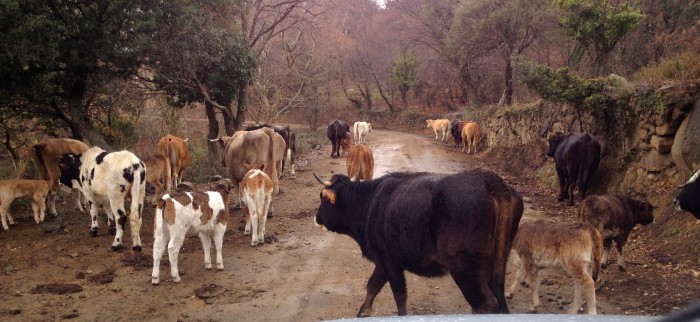
The influence of the Counts of Rosello was overshadowed by the Counts of Rocaberti, who now owned the Château de Requesens and surrounding farms, including the small village of Santa Maria, built in 844, which is even older than the castle itself.
Every year during the first week of June, people from Figueres joined the local residents in the annual procession of the San Sebastian church, praying for the Tramontana wind raging from the mountains to purify their souls for the coming year.
The Counts of Rocaberti were the owners of the Château de Perelada for another 5 centuries.
In the 19th century, Tomas de Rocaberti of Dameto joined the Count of Perelada and the Viscount of Rocaberti to restore the castle to its former glory.
Unfortunately, Tomas de Rocaberti died in 1898 without seeing the complete restoration. But the restoration was completed the following year by his sister, Joanne Adelaida of Rocaberti, who had been his sole heir.
Apparently in those days all women had their share, and Joanne Adelaida of Rocaberti alone knew what led her to pass on all her property to Ferran Truyols Despuig of Mallorca, Marquess of La Torre.
It soon became clear that Ferran did not know what to do with this monumental heritage, and he quickly sold it to the brothers Joan and Pere Rosello of Mallorca. Tragically, they then began a cruel and devastating exploitation of the centuries-old forest that populated the mountains. This exploitation lasted 20 years without regard for the environmental damage they caused.
After this operation in 1920-22, the Rosello brothers then sold the entire mountain to the Duke of Infantado. This then led to further unrest, when the Duke began driving the local farmers out of the land and all the families of the village out of their homes without any form of compensation.
In 1942, the Duke of Infantado then sold the mountains to the Bores Society, who subsequently sold it to the two local families, the Estebans and Pijoans, who remain the owners to this day.
The castle was actually used as a barracks at the end of the Spanish Civil War, housing a company of young men tasked with guarding the border with France. Unfortunately, unaware of its historical value, their neglect of the building led to the destruction of the interior and the battlements of the tower.
They left the castle in ruins, just as it was a hundred years earlier, and it remains as they left it to this day.